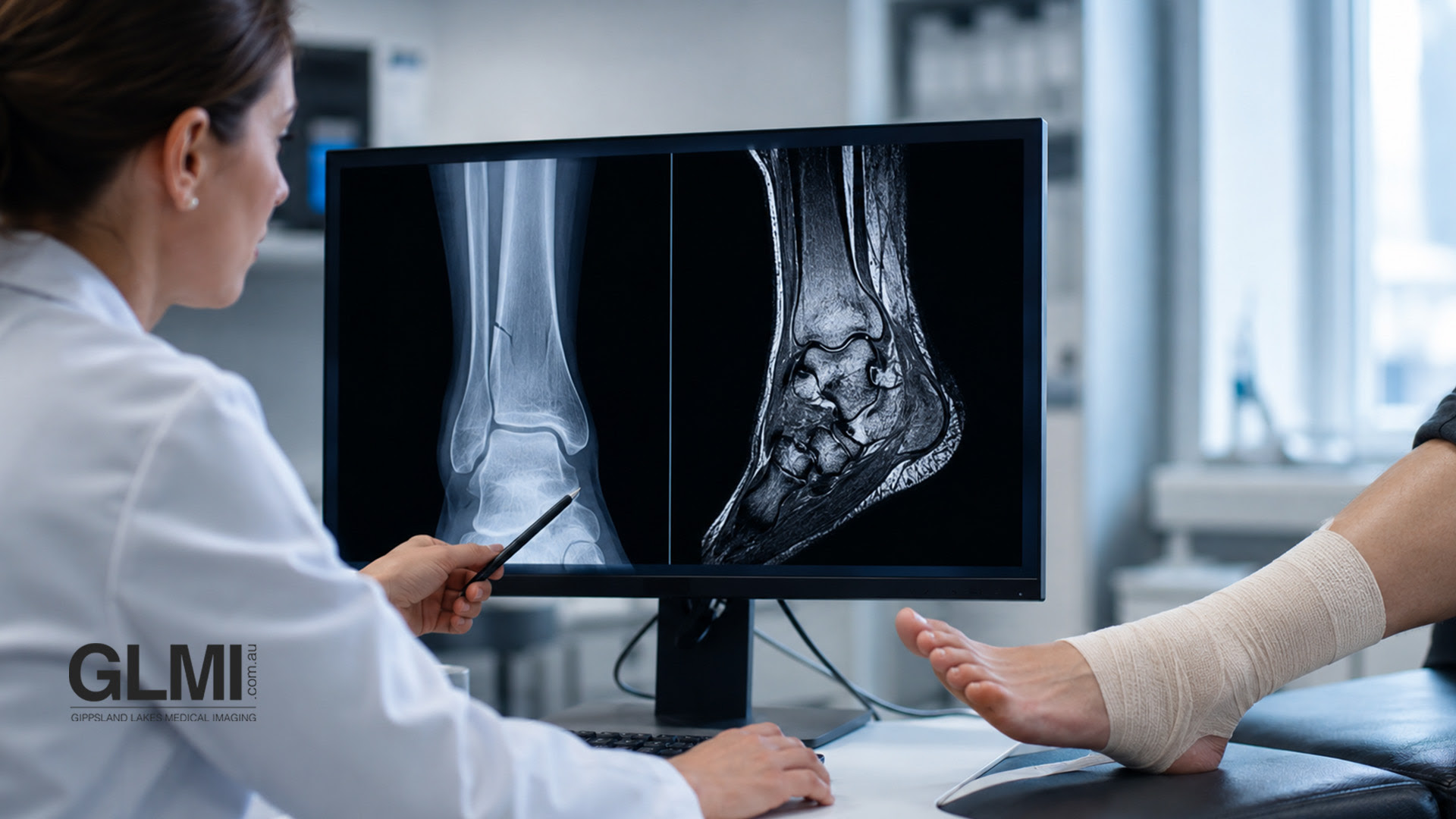
If you’ve recently had a sports injury, you might be asking if it is a soft tissue injury, or is it something more serious? You can’t usually tell simply by looking at it. Medical imaging provides an accurate diagnosis.
A soft tissue injury affects the muscles, tendons and ligaments rather than the bones. Sprains, strains, partial tears and tendon damage all fall into this category, and none of them show up on a standard X-ray. That is one of the reasons so many athletes walk away from an incident thinking they have gotten away with it, only to discover weeks later they have been pushing through a ligament tear or significant tendon damage without proper diagnosis.
Common soft tissue injuries in sport include ankle ligament sprains, hamstring and quadriceps strains, rotator cuff tears, Achilles tendon injuries and knee ligament damage. Left undiagnosed or mismanaged, these injuries lead to longer recovery times and a much higher risk of reinjury down the track.
The ankle sprain vs fracture question is one that catches athletes and clinicians out in equal measure. Both produce bruising, swelling and tenderness around the joint. Both can make weight bearing painful or impossible in the hours after the incident. The difference, however, completely changes the treatment approach.
A fracture requires immobilisation, often a boot or cast, and sometimes surgery. A sprain requires active rehabilitation and physiotherapy. Treating one like the other does not just slow recovery; it risks causing permanent damage to the joint.
An X-ray is the first step in ruling out a bone injury. If the bone is clear, attention shifts to the soft tissue, where ultrasound or MRI can map the extent of ligament and tendon damage with precision.
Unlike an acute fracture from a single impact, a stress fracture develops gradually under repeated load. Runners, AFL players and anyone training at high volume are particularly vulnerable. The signs and symptoms of a stress fracture in the foot are often subtle to begin with, a dull ache that worsens during activity and settles with rest, tenderness along a specific bone, and mild swelling without a clear injury event to point to.
Because stress fractures do not always appear on initial X-rays, further imaging such as MRI or CT may be required to confirm the diagnosis.
CT scanning is often required to confirm the diagnosis. Identifying them early is critical. A partial stress fracture left untreated under continued load can become a complete break.
Once a fracture has been ruled out, musculoskeletal ultrasound becomes one of the most powerful tools available for diagnosing a soft tissue injury. Unlike X-ray, which only captures bone, ultrasound produces real-time images of tendons, ligaments and muscles as they move. A skilled sonographer can observe the tissue dynamically, revealing partial tears, inflammation and structural damage that a static scan would simply miss.
For more complex presentations, particularly those involving the knee, shoulder or spine, CT and MRI provide detailed cross-sectional views that guide decisions around surgery or conservative management.
The right imaging modality depends entirely on the nature of the injury. That combination of clinical judgement and the correct scan is what turns a vague diagnosis into a clear treatment plan.
For athletes across East Gippsland, accessing anything beyond a basic X-ray has traditionally meant a long drive out of the region. Gippsland Lakes Medical Imaging is changing that. As a locally owned, independent practice with purpose built facilities in Bairnsdale and Lakes Entrance, we are here to serve all your imaging needs. At both of these locations, GLMI provides the full range of imaging your treating practitioner might need. Providing digital X-ray, musculoskeletal ultrasounds and CT scanning. Do you need an MRI scan? Please note MRI services are only available at our Bairnsdale location.
Do you live near Sale, Victoria and looking at getting an MRI scan? GLMI is delighted to be opening a new imaging clinic in your area. Be sure to book with us if you require an MRI, or other medical imaging in the future.